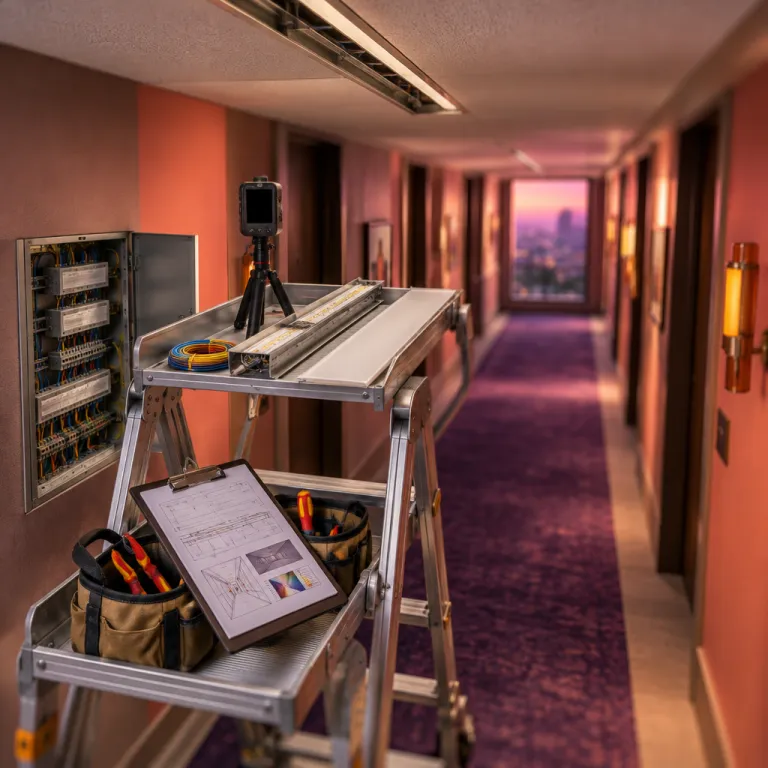
Why circadian lighting in the hotel room is now a performance spec
Circadian lighting in the hotel room has moved from wellness marketing to hard performance criteria. For a hospitality portfolio where around 80% of travelers report sleep issues in unfamiliar environments, the way light behaves in guest rooms is now as material as the mattress. When hotels implement evidence-based circadian lighting to support the circadian rhythm, guest experience scores for sleep can rise significantly, with peer-reviewed studies on light and sleep reporting sleep quality improvements in the range of 25–35% for participants exposed to biologically appropriate light–dark cycles compared with conventional lighting (for example, controlled trials published between 2014 and 2021 on dynamic white lighting and hotel-like environments).
At its core, circadian lighting is lighting designed to align with the body's natural sleep–wake cycle. By mimicking natural daylight patterns with tunable white light and controlled blue light content, it supports the internal clock that governs melatonin, alertness and night sleep. In a lighting hotel strategy, this means treating every hotel room as a calibrated environment where light morning scenes, evening dimming and night lights are specified with the same rigor as HVAC setpoints and acoustic performance targets. For specifiers, this also implies defining how performance will be measured at the eye with calibrated meters, not just described in mood boards.
Premier Inn’s windowless rooms in Edinburgh illustrate how circadian lighting can help guests rest even without natural light from windows. Working with Kazzar Lighting & Controls and amBX, the brand uses dynamic LED luminaires and evidence-based lighting recipes to simulate natural daylight and soft night light transitions. These projects, documented in hospitality trade press and manufacturer case studies from around 2018–2022, move circadian lighting from a decorative feature to a measurable asset, where lighting solutions are commissioned, monitored and tuned to help guests achieve a reliably good night of sleep and where post-occupancy reviews can be compared with pre-installation baselines.
24 hour color temperature and lux schedules by room type
Designing lighting for circadian rhythms starts with a 24 hour schedule, not a fixture schedule. For each category of guest rooms and suites, the lighting design team should define target lux levels at the eye, correlated color temperature ranges, melanopic or circadian stimulus targets and blue light exposure windows that align with typical arrival, work and rest patterns. In a business hotel, for example, you may want higher vertical illuminance and cooler white light in the late afternoon to support work, then a warm, low intensity light profile that gently prepares the guest for night sleep.
For standard rooms, a robust baseline is around 250–300 lux vertical at the eye in the morning with a neutral white light around 3,500–4,000 K and a melanopic equivalent daylight illuminance (EDI, a metric that weights light by its impact on the circadian system rather than visual brightness) of roughly 150–250 lux, rising to 400 lux task lighting at the desk for work. As the evening progresses, the circadian lighting profile should drop below 150 lux in the main spaces, with warmer white light around 2,700 K, melanopic EDI below about 50 lux and reduced blue light content to protect the circadian rhythm. Night lights in the bathroom and circulation zones should sit below 5 lux at floor level, using very warm light to help guests navigate without disrupting melatonin or the overall guest experience.
Suites and long-stay rooms can justify more granular scenes, with separate circadian lighting hotel room profiles for lounge, work and sleep zones. Here, natural daylight access must be measured and integrated, so that artificial lights only supplement when natural light is insufficient for the intended activity. For technical directors and asset managers, this 24 hour matrix becomes a contractual document in the hotel design package, aligning operators, engineering consultants and suppliers around measurable lighting hotel performance rather than subjective ambience. A simple example table might specify morning (07:00–10:00, 300 lux vertical, 3,800 K), day (10:00–18:00, 250 lux, 3,500 K), evening (18:00–22:00, 100 lux, 2,700 K) and night (22:00–07:00, <5 lux, <2,400 K) as verifiable targets.
Choosing the right control backbone: DALI, Casambi and hybrid buses
The circadian lighting hotel room concept fails quickly if the control backbone is wrong for the ownership profile. DALI offers robust, addressable wired control that suits new-build hotels with strong technical services teams and clear pathways for control cabling, while Casambi and similar wireless systems can be more appropriate for phased renovation where opening walls is limited. For asset managers balancing CAPEX and OPEX, the choice between a fully wired bus and a wireless mesh is less about fashion and more about maintenance regimes, staff training and long-term interoperability with other hospitality systems.
DALI-based lighting solutions give precise channel control, reliable dimming curves and straightforward integration with building management systems, which is valuable when you want consistent circadian lighting across hundreds of rooms. Wireless platforms such as Casambi can reduce installation cost and duration, especially in heritage hotels where invasive works are constrained, but they demand careful RF planning and a clear strategy for firmware updates over the asset life. In both cases, specifying gateways that can talk to PMS, door lock systems and HVAC controllers is essential if you want the circadian rhythm schedule to respond to real occupancy rather than fixed time clocks.
Vendors like amBX add a software layer that translates circadian lighting design intent into dynamic scenes, using tools such as SmartCore (a control platform that sequences color temperature, intensity and timing) to run evidence-based lighting recipes across multiple spaces. When you send the bid documents to the market, the lighting hotel specification should state the required protocol, minimum channel counts per hotel room (for example, at least four channels for ceiling, task, accent and night lighting, where a channel is a separately dimmable or tunable group of luminaires), and how guest rooms must fail safe if controls go offline, such as reverting to a low-energy, warm-white default profile that still protects sleep. For innovation leads, attending a lighting trade show focused on hospitality architecture and design can be an efficient way to benchmark DALI, Casambi and hybrid ecosystems against real-world hotel constraints.
Interfaces, integrations and what not to hand to the guest
The most elegant circadian lighting design collapses if the interface confuses the guest or the housekeeping team. A hotel room needs a simple hierarchy of controls where the base circadian lighting schedule runs automatically, while the guest can override with a few clear scenes such as light morning, work, relax and night, ideally via hard buttons rather than only via an app or voice. Overly complex touch panels that expose every circuit and color channel may look premium, but they often lead to guests leaving all lights on or disabling the system, which harms both sleep and energy performance.
From a technology standpoint, the control logic should integrate with blackout blinds, HVAC and even the smart TV mute state. When the guest activates a good night scene, the system can close blackout, reduce white light to a very warm low level, mute the TV and set HVAC to a sleep-optimized temperature band, all while keeping a low-level night light in the bathroom to help guests move safely. Voice control can be offered as an accessibility layer, but it should never be the only way to adjust lights, because network outages or language barriers can quickly degrade the guest experience.
Back of house, dashboards for technical services should show room-by-room status of lights, scenes and faults, with the ability to push updated circadian rhythms or daylight compensation curves across zones. Integration with PMS allows the system to shift from day to night profiles based on check-in and check-out times, not just clock time, which is crucial for red-eye arrivals who need immediate rest. For deeper context on how such integrated systems shape the identity of hospitality spaces, analysis of architectural narratives in contemporary hotel design can be instructive, as seen in discussions of stone, light and spatial intention on specialist design for travel platforms.
Protecting the specification and measuring post opening performance
Value engineering is where many circadian lighting hotel room strategies quietly die. To protect the specification, the tender package must include not only fixture counts but performance requirements for circadian lighting, such as minimum vertical illuminance in the morning, maximum blue light content after a defined evening time, minimum melanopic EDI targets for daytime and mandatory night lights in circulation paths. These requirements should be tied to mock-up room testing, where asset managers, designers and lighting consultants verify that the hotel room delivers the intended guest experience before bulk procurement.
Commissioning needs a structured protocol that goes beyond checking whether lights turn on. For each room type, the commissioning agent should validate the 24 hour schedule, confirm that natural daylight sensors are calibrated, and test that scenes such as light morning, relax and good night transition smoothly without flicker or abrupt shifts that could disturb sleep. A concise commissioning checklist should also cover channel addressing, emergency and fail-safe behaviour, PMS and HVAC integrations, time synchronisation, firmware versions and handover of as-built control drawings and passwords to the operator, alongside a brief note on how vertical illuminance and melanopic EDI will be re-checked with portable meters during seasonal reviews.
Post opening, success metrics should combine technical data and human feedback. On the technical side, monitor dimming profiles, energy use, fault rates and data-logging of scene overrides across guest rooms, while on the human side, track guest NPS, sleep quality scores and duration of stay for rooms with full circadian lighting versus legacy lighting solutions. Independent research notes that hotels implementing evidence-based wellness design can see sleep quality scores improve by around one third, and when “hotels are integrating circadian lighting to enhance guest sleep quality” and “by mimicking natural light patterns, it supports the body's internal clock”, the business case for maintaining specification integrity becomes difficult to ignore.
Designing for windowless and low daylight rooms without compromising wellness
Windowless or low daylight rooms are where circadian lighting proves its value most clearly. Premier Inn’s projects in Edinburgh show that with carefully designed lighting hotel strategies, even internal rooms can support healthy circadian rhythms by simulating natural daylight arcs from cool, bright morning light to warm, dim evening light. For investors and asset managers, this opens up deep-plan floor plates and basement spaces for revenue-generating guest rooms without sacrificing guest rest or brand standards.
In these constrained spaces, the design of the luminous surface matters as much as the spectrum. Large-area ceiling or wall panels, such as horizon-style luminaires, can create a convincing sense of natural light and sky, while indirect lights wash walls to avoid glare and visual fatigue. The circadian lighting hotel room schedule should be slightly conservative on blue light intensity, because without real natural daylight to anchor the circadian rhythm, over-aggressive white light in the evening can push sleep onset later than desired.
For FF&E suppliers, this context changes the brief for bedside luminaires, task lights and decorative fixtures. Every element must support the overall circadian lighting narrative, with bedside lights that dim to very low levels for night reading, integrated night lights that help guests reach the bathroom safely, and finishes that reflect light softly rather than creating harsh contrasts. When these details align, even compact internal rooms can deliver a calm, wellness-oriented guest experience that competes with larger rooms in more generous architectural spaces, reinforcing the strategic value of circadian-aware hotel design across the portfolio.
FAQ
What is circadian lighting in a hotel room ?
Circadian lighting in a hotel room is a lighting strategy designed to align artificial light with the human circadian rhythm, the internal clock that regulates sleep and wake cycles. It uses tunable white light, controlled blue light content and time-based scenes to mimic natural daylight patterns from morning to night. In hospitality projects, this approach aims to help guests fall asleep more easily, wake up more refreshed and feel more comfortable in unfamiliar rooms, while giving owners measurable performance criteria they can test with light meters and guest feedback.
How does circadian lighting improve guest sleep ?
Circadian lighting improves guest sleep by managing the spectrum and intensity of light across the day. Bright, cooler white light with more blue wavelengths in the morning supports alertness, while warmer, dimmer light in the evening reduces blue light exposure and allows melatonin to rise. As expert guidance states, “How does circadian lighting improve sleep? By mimicking natural light patterns, it supports the body's internal clock.” In practice, this means specifying morning scenes with higher melanopic EDI and evening scenes with very low melanopic stimulus and carefully controlled night lights.
Which hotels are already using circadian lighting systems ?
Several hotel brands are piloting or rolling out circadian lighting systems in selected properties. Premier Inn has implemented dynamic circadian lighting in some windowless rooms in locations such as Edinburgh, working with partners like Kazzar Lighting & Controls and amBX. These projects use tunable LED luminaires and smart control software to simulate natural daylight and gentle night lights, with the goal of improving guest sleep quality and overall satisfaction, and they are often referenced in case studies and conference papers on hotel wellness design.
What should be included in a circadian lighting specification for new hotels ?
A robust circadian lighting specification for new hotels should define 24 hour color temperature and lux schedules by room type, including target vertical illuminance at the eye, melanopic or circadian stimulus targets and limits on blue light in the evening. It should state the preferred control protocol, such as DALI or Casambi, integration requirements with PMS, HVAC and blinds, and minimum performance criteria for scenes like light morning, work and good night. The specification must also include commissioning procedures, mock-up room acceptance criteria, data-logging metrics, and post-opening monitoring of guest feedback and energy performance, so that the circadian lighting concept remains auditable over the life of the asset.
Can circadian lighting work in existing hotels without major renovation ?
Circadian lighting can be retrofitted into existing hotels, especially when using wireless control platforms and plug-and-play luminaires. In many cases, replacing fixed white fixtures with tunable white or RGBW luminaires and adding smart controls allows designers to create morning, day and night scenes without opening walls extensively. Success depends on careful survey of existing electrical infrastructure, realistic phasing plans and clear training for operations teams so that the new system supports, rather than complicates, daily hospitality workflows, and so that staff can verify that target lux and color temperature levels are being achieved in occupied rooms.