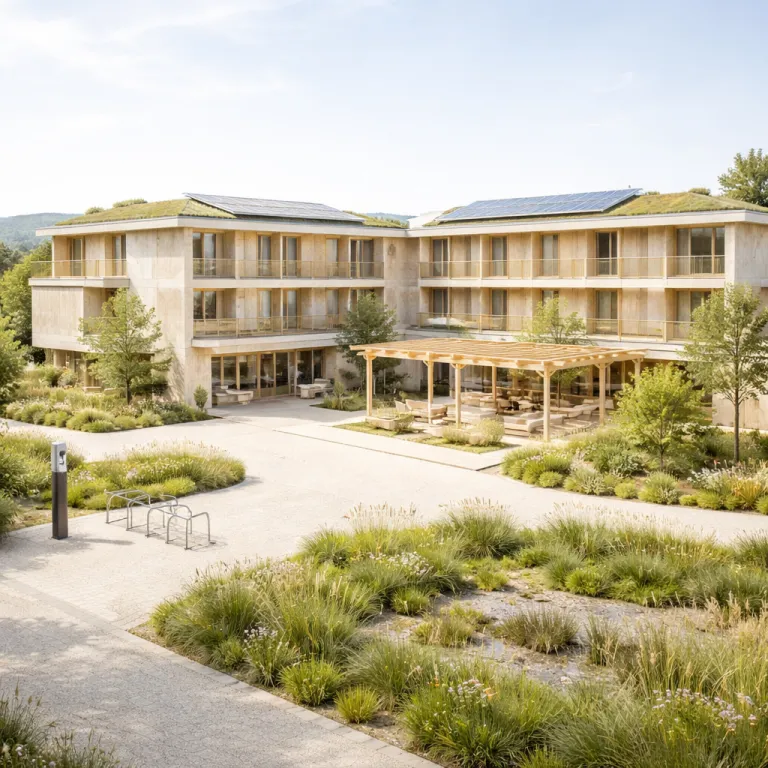
From slogans to specifications in sustainable hotel design
Sustainable hotel design has moved from marketing copy to procurement criteria. Corporate travel buyers now check whether each hotel aligns with measurable sustainability benchmarks, not just whether it feels eco friendly. For any property above 100 rooms, this shift is reshaping how architects, designers, and technical directors plan the building from shell to FF&E.
For operators, the question is no longer if a sustainable hotel strategy matters, but which sustainable practices and certifications actually influence preferred vendor status. The hospitality industry is under pressure to reduce environmental impact while still delivering luxury experiences that justify rate premiums and protect long term asset value. That tension plays out in every decision, from façade performance and energy saving systems to how hotel rooms handle water waste and food waste without compromising guest comfort.
Genuinely sustainable hotels now treat sustainability as a design constraint, not a decorative layer. Architects and bureaux d’études work with environmental consultants from concept stage to model energy and water performance, then translate those models into concrete specifications for the building envelope, MEP, and FF&E. As one expert summary puts it with useful clarity: “What is sustainable hotel design? Designing hotels to minimize environmental impact.”
That definition sounds simple, yet applying it to a 300 room luxury hotel with multiple restaurants, a spa, and event spaces is complex. Each space type has different energy, water, and waste profiles, and sustainable luxury means calibrating these profiles without eroding perceived value for guests. The best sustainable hotel projects therefore integrate eco conscious choices into the architecture and interior design so that green hotels feel effortless, while back of house systems quietly handle the heavy lifting.
Across global markets, sustainable hotel design now follows a similar pattern. Developers and investors mandate a target certification such as LEED, Green Key, EarthCheck, or a Verified Net Zero pathway, then ask architects to translate that into a coherent design and procurement roadmap. Hotel operators and their teams must then maintain sustainable practices in daily operations, ensuring that eco friendly intent survives value engineering, brand standards, and the realities of occupancy swings in both boutique hotels and large luxury hotels.
LEED for hospitality: where the easy wins end
LEED remains the most globally recognized green building framework for a hotel, but not all credits are created equal for hospitality. For a new build or major renovation, the low hanging fruit in sustainable hotel design usually sits in energy and water categories, where EHL Insights reports that energy savings in sustainable hotels can reach around 30 % and water savings around 20 % (EHL Insights, “Sustainability in Hospitality: How Hotels Can Reduce Their Environmental Impact,” 2021, pp. 4–6). Those numbers are realistic when the building envelope, HVAC, and water systems are designed together rather than retrofitted piecemeal.
On the energy side, LEED points tied to high performance façades, efficient chillers, heat recovery, and smart room controls are often the best ROI for both boutique hotel projects and large hotels. Energy saving measures such as variable speed drives, demand controlled ventilation, and integrated building management systems can cut operational energy while improving guest comfort in hotel rooms. For GMs and asset managers, these measures reduce long term operating costs and support sustainability narratives that resonate with eco conscious corporate clients.
Water related credits demand equal attention in any sustainable hotel. Specifying low flow fixtures, greywater reuse where regulations allow, and sub metering by zone helps track water waste and align with sustainable practices that auditors now expect to see documented. In kitchens and back of house, design decisions around dishwashing systems, pre rinse sprays, and food preparation areas directly influence both water use and food waste, which in turn shape the environmental impact profile of the hotel’s food and beverage operations.
Material credits in LEED can be more nuanced for hospitality projects. Reclaimed wood, bamboo, and recycled metal can be powerful tools in sustainable luxury narratives, but only when backed by clear chain of custody documentation and durability testing suitable for high turnover hotel rooms and public areas. For FF&E suppliers, this means aligning product lines with both LEED criteria and the operational realities of hotels, where operators must balance eco friendly materials with cleanability, fire ratings, and replacement cycles.
For design teams focused on FF&E, case based guidance on sustainable specifications is increasingly valuable. Detailed frameworks such as those discussed in analyses of sustainable FF&E strategies for eco conscious hospitality design help bridge the gap between certification language and actual product schedules. When architects, interior designers, and procurement managers align early on LEED priorities, they avoid late stage compromises that dilute both sustainability outcomes and guest facing design quality.
Green Key and the operational reality of sustainable hotels
While LEED focuses heavily on the building, Green Key goes deep into how hotels operate day to day. For a sustainable hotel seeking to reassure corporate travel buyers, Green Key certification signals that sustainability is embedded in management routines, staff training, and guest communication. This operational lens is particularly relevant for existing hotels and boutique hotels where structural changes are limited but sustainable practices can still be upgraded.
Green Key criteria touch almost every department in a hotel. Housekeeping procedures, laundry operations, food and beverage, purchasing, and maintenance all face specific requirements around energy, water, chemicals, and waste, which means the technical director and GM must work closely with each team. For FF&E and OS&E procurement, Green Key pushes properties to prioritize eco friendly and durable products, from LED lighting and energy saving minibars to refillable amenity dispensers that cut plastic waste in hotel rooms.
Food and beverage operations are a particular focus, because food waste and water waste in kitchens can undermine otherwise strong sustainability performance. Green Key aligned hotels are expected to track food waste, optimize menu engineering, and favor local and seasonal food sourcing where possible, which reduces environmental impact while strengthening the guest narrative. For luxury hotel brands, this is an opportunity to position sustainable luxury as a story of terroir, craftsmanship, and responsible sourcing rather than just a smaller portion size.
For corporate buyers, Green Key offers a recognizable shorthand that a hotel’s sustainability claims are audited and not just self declared. Accor’s decision to partner with Green Key and Green Globe, with a target of 100 % eco certified hotels across its portfolio by 2030 (Accor, “Accor and Green Key sign a global partnership agreement,” press release, 2023), shows how mainstream this operational certification has become for the hospitality industry. Analyses of the impact of green building certifications on hotel architecture and design underline that Green Key often complements, rather than replaces, asset level frameworks like LEED.
For GMs and asset managers, the implication is clear. Securing and maintaining Green Key status requires a robust documentation trail, from energy and water consumption data to supplier invoices and staff training logs, and auditors will check that these documents match on site reality. When architects and designers understand these operational clauses early, they can specify storage, sorting, and control spaces that make it easier for hotels to comply without turning back of house areas into chaotic afterthoughts.
EarthCheck, Verified Net Zero and the carbon narrative
As climate reporting tightens, carbon performance has become a decisive factor in sustainable hotel design. EarthCheck and Verified Net Zero style programs move beyond generic sustainability to quantify a hotel’s greenhouse gas emissions and reduction pathways. For investors and asset managers, these frameworks help translate sustainability into measurable risk management and long term asset resilience.
EarthCheck is particularly strong in resort and destination contexts, where the environmental impact of a hotel extends into local ecosystems and communities. Its methodology covers energy, water, waste, and social indicators, which suits large hotels and luxury hotels with complex footprints and multiple food and beverage outlets. For architects and technical teams, this means designing building systems that can generate granular data on energy saving performance, water use, and waste streams, because EarthCheck auditors will expect to see hard numbers rather than aspirational statements.
Verified Net Zero style programs, such as those referenced in Radisson Hotel Group’s “Verified Net Zero” meetings initiative launched in 2022 (Radisson Hotel Group, “Radisson Meetings achieves 100% carbon neutral status,” 2022), focus more narrowly on carbon accounting and reduction trajectories. For an urban boutique hotel or a business focused luxury hotel, this can be the better call when corporate clients prioritize science based targets and emissions transparency. In such cases, sustainable hotel design must prioritize deep energy efficiency, low carbon materials, and credible renewable energy sourcing over more cosmetic eco gestures.
Choosing between EarthCheck and a Verified Net Zero pathway depends on the property’s typology, market positioning, and existing data maturity. A coastal resort with extensive grounds, multiple pools, and high water use may gain more from EarthCheck’s holistic lens, especially if local community engagement is central to the brand story. A city centre hotel targeting global corporate accounts may find that a clear Net Zero roadmap, combined with LEED or Green Key, delivers the best alignment with buyer expectations.
In both cases, the documentation trail is non negotiable. Architects, MEP engineers, and FF&E suppliers must anticipate the need for Environmental Product Declarations, lifecycle assessments, and sub metered data streams, because auditors will check that claimed energy saving and water saving measures are real. For operators, this means that sustainable practices are not just about being eco friendly in spirit, but about maintaining verifiable records that can withstand scrutiny from both certifiers and increasingly eco conscious guests.
Materials, FF&E and the line between real and performative eco
Material choices are where sustainable hotel design often risks slipping into greenwashing. Reclaimed wood feature walls, bamboo flooring, and recycled metal details photograph beautifully, yet without robust sourcing and durability data they can become liabilities in high traffic hotel environments. The hospitality industry now faces sharper questions from both auditors and guests about whether these materials genuinely reduce environmental impact over the full lifecycle.
For architects and interior designers, the first filter is performance. Flooring in hotel rooms, corridors, and lobbies must withstand rolling loads, cleaning chemicals, and constant foot traffic, which means that some eco materials are better suited to accent areas than to primary circulation zones. Reclaimed wood can work brilliantly on ceilings, headboards, or bar fronts when properly treated, while recycled metal is often ideal for casegoods hardware, lighting, and decorative screens that support a sustainable luxury narrative without compromising robustness.
FF&E suppliers serving sustainable hotels increasingly provide third party verified data. Environmental Product Declarations, FSC or PEFC certifications, and low VOC finishes are now baseline expectations for eco conscious projects, especially where Green Key or LEED credits are in play. For hotels that want to be genuinely eco friendly, procurement clauses should specify not only material content but also repairability, modularity, and take back schemes that reduce waste at the end of each product’s life.
Soft goods and operational items also matter. Bedding, towels, and textiles in hotel rooms can support sustainability through organic or recycled fibres, yet they must also meet strict laundering and fire safety standards, which is where experienced suppliers add real value. In restaurants and bars, tableware, menus, and back of house equipment influence both food waste and water waste, so design teams should coordinate closely with chefs and F&B managers to align layout, storage, and equipment with sustainable practices.
For brands such as Melia Hotels International and other global groups, aligning portfolio wide FF&E standards with local sourcing is a strategic challenge. Centralized design guidelines must leave room for local materials and crafts that reduce transport emissions and strengthen the sense of place for guests, especially in boutique hotels and lifestyle properties. When done well, this approach turns each sustainable hotel into a case study in how local building traditions and contemporary green technologies can coexist in a coherent, guest centric design language.
Designing operations: where GMs turn sustainability into P&L
For a GM, sustainable hotel design only matters if it translates into operational excellence and a stronger P&L. Energy saving systems, water efficient fixtures, and waste management infrastructure must be intuitive for teams to use, or they will underperform and erode both ROI and certification scores. This is where early collaboration between architects, hotel operators, and environmental consultants becomes decisive.
Back of house planning is often the hidden determinant of sustainability success. Adequate space for waste sorting, linen handling, and food waste collection allows teams to follow sustainable practices without adding friction to daily routines, which is critical in both large hotels and compact boutique hotels. When these spaces are undersized or poorly located, staff will naturally bypass systems, and the hotel’s environmental impact will drift away from the design intent.
Guest facing systems also require careful design. Smart room controls that manage lighting, HVAC, and blinds can deliver significant energy savings, but only if guests understand them and do not feel constrained, so interface design and clear in room communication are essential. Hotels that frame these controls as part of a premium, tech forward experience tend to see better adoption, especially among eco conscious travellers who actively seek sustainable hotels and are willing to engage with green features.
Food and beverage operations remain a major lever for both sustainability and guest satisfaction. Kitchen layouts that support batch cooking, portion control, and efficient dishwashing can reduce food waste and water waste while improving workflow, which directly affects labour costs and service quality. For luxury hotels, rethinking buffets, banqueting, and minibar offerings through a sustainability lens can unlock both cost savings and a more curated, sustainable luxury positioning.
Real world case studies illustrate the financial impact. The ITC Maurya in New Delhi, for example, reported energy savings of more than 30 % and water savings of around 20 % after implementing integrated efficiency measures and achieving LEED Platinum certification (U.S. Green Building Council, “ITC Maurya, a Luxury Collection Hotel, New Delhi,” LEED project profile, 2016). Similarly, Scandic Hotels has documented a reduction of food waste per guest by approximately 40 % over a decade through systematic measurement and kitchen process redesign, demonstrating how operational changes can materially shift a hotel’s footprint.
Finally, data is the connective tissue that links design, operations, and certification. Sub metering, digital maintenance logs, and integrated building management systems provide the evidence that auditors, owners, and corporate clients now expect, and they also enable continuous optimisation of energy and water performance. For deeper context on how digital ecosystems are reshaping these workflows in architecture and FF&E, analyses of privacy centric digital workflows in hotel architecture and FF&E design show how data governance and design decisions increasingly intersect.
Strategic choices for owners, brands and design teams
Owners and brands now face a strategic choice in how far to push sustainable hotel design. At one end, a light touch approach focuses on visible eco gestures and incremental energy saving upgrades, which may satisfy some leisure guests but rarely moves the needle with corporate travel buyers. At the other end, a fully integrated strategy aligns building performance, certifications, and brand storytelling to position the hotel as a credible leader in sustainability.
For existing assets, deep energy retrofits and water system upgrades can be phased over several years. Replacing legacy HVAC with high efficiency systems, improving insulation, and installing smart controls can deliver substantial reductions in energy use and operating costs, especially in older luxury hotels with high baseline consumption. Pairing these upgrades with Green Key or similar operational certifications helps signal progress to the market while building the documentation base needed for more ambitious frameworks like EarthCheck or Verified Net Zero pathways.
New build projects have the advantage of starting from a clean slate. Here, architects and developers can orient the building for passive gains, integrate on site renewables such as solar panels, and design rainwater harvesting or greywater systems that reduce dependence on municipal supplies, particularly in water stressed regions. When combined with circular design principles, upcycling of construction waste, and invisible sustainability strategies that hide technical complexity from guests, these choices create hotels that are both future ready and operationally efficient.
Brand positioning also shapes the sustainability roadmap. Boutique hotels may lean into local materials, community partnerships, and low impact operations to create an intimate, eco friendly narrative, while large chain hotels such as Melia Hotels might prioritize portfolio wide standards and scalable technologies. In both cases, the best outcomes arise when sustainability is treated as a core design driver rather than a late stage add on, with clear KPIs linked to both environmental impact and guest satisfaction.
For all stakeholders, from architects and designers to asset managers and FF&E suppliers, the message is consistent. Sustainable hotel design is now a competitive necessity, not a niche, and the hospitality industry actors who align building performance, operational excellence, and credible certifications will secure both corporate demand and long term asset resilience. The hotels that succeed will be those where every decision, from façade detailing to minibar curation, is checked against a simple question: does this choice support a more sustainable, guest centric, and financially robust future for the property.
Key figures shaping sustainable hotel design
- EHL Insights reports that energy savings in sustainable hotels can reach around 30 %, illustrating the scale of potential operating cost reductions when energy saving systems are integrated from the design stage (EHL Insights, “Sustainability in Hospitality: How Hotels Can Reduce Their Environmental Impact,” 2021, p. 5).
- According to the same EHL Insights data, water savings in sustainable hotels average about 20 %, which is particularly relevant for properties in water stressed regions where tariffs and regulatory pressure are rising (EHL Insights, 2021, p. 6).
- Global hotel groups such as Accor have set targets for 100 % eco certified hotels across their portfolios by 2030, signalling that sustainability certifications like Green Key, LEED, and EarthCheck are becoming baseline expectations rather than differentiators (Accor, global partnership announcement with Green Key and Green Globe, 2023).
- Industry analyses of Radisson Hotel Group’s Verified Net Zero program, launched in 2022, show that corporate clients increasingly request clear carbon reduction pathways, pushing hotels to document emissions and align with science based targets (Radisson Hotel Group, “Verified Net Zero meetings,” 2022 briefing).
- Studies compiled by MYBOS on green certifications for hotels (MYBOS, “The Importance of Green Certifications in the Hotel Industry,” 2022) highlight that properties with recognized sustainability labels often see improved corporate RFP performance, as buyers use certifications as a quick filter in preferred vendor selection.
FAQ about sustainable hotel design
What is sustainable hotel design in practical terms ?
Sustainable hotel design means planning and operating hotels to minimize environmental impact across energy, water, materials, and waste while maintaining or enhancing guest experience. It covers everything from building orientation and HVAC efficiency to FF&E choices, food waste management, and staff training. Certifications such as LEED, Green Key, and EarthCheck provide structured frameworks to measure and verify these efforts.
Why is sustainable hotel design important for GMs and owners ?
For GMs and owners, sustainable hotel design directly affects operating costs, risk exposure, and access to corporate demand. Efficient systems reduce energy and water bills, while credible certifications help win preferred vendor status with eco conscious corporate buyers. Over the long term, sustainable practices also protect asset value by aligning with tightening regulations and investor expectations on climate and ESG performance.
How do hotels implement sustainable design in existing buildings ?
Existing hotels typically start with energy and water audits to identify quick wins and deeper retrofit opportunities. Upgrades may include LED lighting, smart room controls, high efficiency boilers or chillers, low flow fixtures, and improved insulation, combined with better waste sorting and food waste reduction programs. Many properties then pursue operational certifications like Green Key to structure and validate these improvements.
Which sustainability certifications matter most for hotels ?
LEED is widely recognized for building performance, Green Key focuses on operational sustainability, and EarthCheck offers a comprehensive framework often used by resorts and destination properties. Verified Net Zero style programs, such as those referenced in Radisson’s initiatives, concentrate on carbon accounting and reduction pathways. The best choice depends on the hotel’s typology, market, and strategic priorities, and many properties combine more than one certification.
How do guests influence sustainable hotel design choices ?
Guests increasingly expect hotels to be eco friendly without sacrificing comfort, which shapes design decisions around room controls, amenities, and F&B concepts. Eco conscious travellers often prefer hotels that transparently communicate their sustainability efforts and certifications, influencing booking behaviour and online reviews. This demand feedback loop encourages owners and brands to invest in genuine sustainable practices rather than purely cosmetic green features.