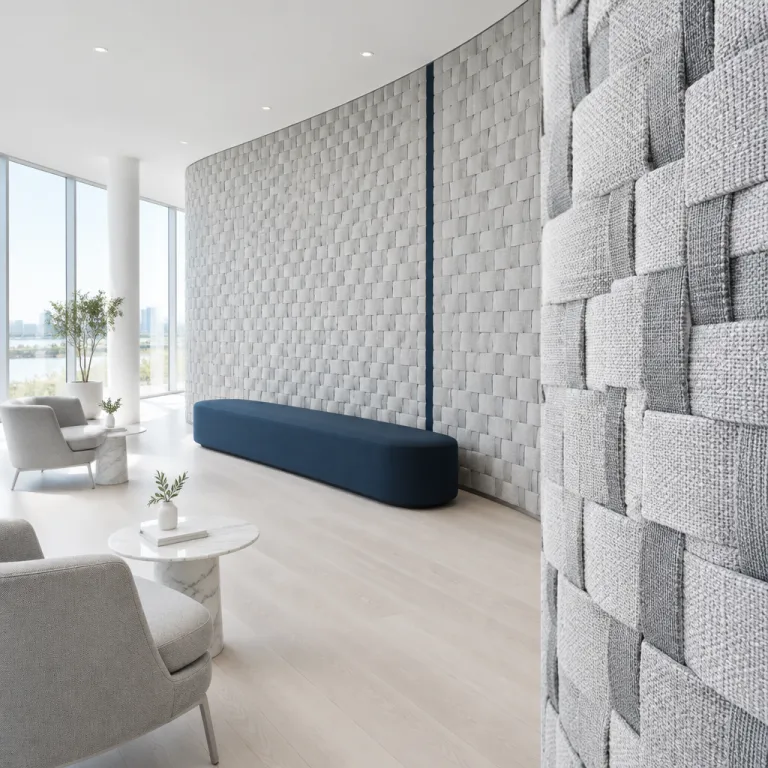
From statement wall to silent partner: positioning woven image 442 in hospitality projects
Woven image 442 sits at the intersection of acoustic performance and refined textile expression. In upscale hotels and resorts, this woven surface becomes both an environmental product decision and a guest experience lever, especially where lobby volumes and F&B spaces generate challenging acoustics. For architects, hospitality designers, technical services teams and asset managers, the product is less a decorative item and more a strategic acoustic panel system that stabilises health, comfort and operational efficiency.
When you specify woven image 442 as a primary wall or ceiling material, you are implicitly making a product declaration about noise control, maintenance and long term product health. The woven image range, including the 442 reference, is typically paired with an Echopanel acoustic backing, creating a composite wall panel that balances tactile depth with measurable sound absorption. Typical Echopanel substrates in hospitality applications achieve NRC values in the 0.70–0.85 range (depending on thickness and air gap), which allows FF&E teams to rationalise items across guestrooms, corridors and public areas while maintaining a coherent image and consistent environmental product profile.
For investors and bureaux d’études, the value of woven image 442 lies in its alignment with environmental and health declaration frameworks, especially where Global Greentag or similar schemes are part of the asset strategy. A clear product declaration and environmental product sheet for each woven image reference simplifies technical due diligence during acquisition or refinancing. When the acoustic panel system is supported by transparent data on low VOC emissions (for example, compliance with ISO 16000 or equivalent tests), recycled PET content and red list free chemistry, it becomes easier to integrate into portfolio wide ESG reporting and long term capex planning.
Material intelligence: echopanel, recycled PET and the environmental product narrative
Behind the visual softness of woven image 442 sits a more technical story about Echopanel substrates and recycled PET fibres. Many hospitality projects now require an environmental product declaration (EPD) or at least a concise product health declaration to satisfy both brand standards and investor expectations. When Echopanel is used as the core acoustic panel material, often with high levels of post consumer recycled PET content, the specification supports measurable reductions in embodied impacts while maintaining robust acoustic performance.
Designers who work with woven image textiles over Echopanel panels should request the full sheet Echopanel documentation, including any Global Greentag or Greentag Greenrate certifications. These documents, sometimes grouped as an Echopanel brochure or technical sheet, typically outline Greenrate level ratings, low VOC testing protocols, red list free status and cleaning or Echopanel care recommendations. In practice, this environmental and health declaration package helps technical services teams compare different acoustic panel items on more than aesthetics alone, especially when brand audit teams scrutinise environmental product choices.
For hospitality interiors where colour and light play a central role, the material logic behind woven image 442 can be aligned with other finish strategies such as pink back painted glass in bars or spa reception areas. When you coordinate a reflective glass surface with a woven acoustic panel, you balance reverberant and absorptive materials in a controlled way that supports both acoustics and visual drama; a detailed case study of this approach can be seen in this analysis of how back painted glass reshapes hospitality interiors and FF&E strategies. The key is to treat each product, from Echopanel installation to glass cladding, as part of a single environmental product narrative that can be defended in front of both sustainability officers and brand design review boards.
Acoustics as a design tool: performance, health and guest perception
In hospitality, acoustics are no longer a purely technical afterthought; they shape perceived luxury as strongly as lighting or bedding. Woven image 442, when combined with an Echopanel backing, offers a calibrated acoustic panel solution that can be tuned to different spaces, from intimate lounges to high volume all day dining rooms. The woven surface diffuses high frequencies while the Echopanel core absorbs mid range noise, creating a more even sound field that supports both privacy and social energy.
From a health perspective, quieter rooms and controlled reverberation times contribute to lower stress levels for guests and staff, which is increasingly referenced in product health and health declaration frameworks. Low VOC adhesives, list free or red list free chemistry and recycled PET content in the Echopanel material all support better indoor air quality, especially in sealed high rise hotels where mechanical ventilation dominates. When these environmental and health factors are clearly summarised in a product declaration or environmental product sheet, asset managers can link acoustics investments directly to ESG metrics and long term portfolio resilience.
Acoustic performance also intersects with FF&E strategy, particularly in how loose items and fixed finishes interact. A woven image acoustic panel behind banquette seating, for example, allows designers to specify lighter, more sculptural chairs without sacrificing speech clarity or comfort; this balance between furniture language and material performance is explored in depth in the analysis of how chair language reshapes hotel furniture and lighting strategies. When acoustics, furniture and lighting are conceived as a single system, woven image 442 becomes a quiet but decisive player in the overall guest experience.
From specification to installation: guides, sheets and operational care
Specifying woven image 442 is only the first step; the real test comes at installation and over the operational life of the hotel. Technical services teams and bureaux d’études should insist on a detailed installation guide for every acoustic panel configuration, including any specific Echopanel installation requirements for curved walls, ceilings or integration with MEP elements. A clear installation guide, ideally supported by a project specific Echopanel brochure and sheet Echopanel drawings, reduces on site improvisation and protects both acoustic performance and fire ratings such as EN 13501-1 or ASTM E84 classifications.
During tendering, contractors should receive a concise list of required items, from fixing systems to edge trims, along with the relevant product declaration and environmental product documentation. This package should also include Echopanel care and cleaning instructions, since improper cleaning regimes can damage the woven surface or compromise the acoustic panel’s appearance in high traffic hospitality environments. When the Echopanel care sheet and woven image cleaning guide are integrated into the hotel’s standard operating procedures, the product health and visual quality of the installation are preserved for longer cycles, which directly benefits capex planning.
FF&E suppliers who coordinate casegoods, seating and wall finishes can also align woven image 442 with other material strategies such as B&B plate or metal inlays, as explored in this analysis of how plate strategies elevate hotel interiors through materials and finishes. By treating the woven image acoustic panel as a core architectural finish rather than a decorative afterthought, the installation guide, Echopanel installation details and product health documentation become part of the same technical narrative as stone, metal and glass. This integrated approach reduces clashes on site and supports a more coherent handover from construction to operations.
Certification, Greentag Greenrate and portfolio level decision making
For investors and asset managers, the appeal of woven image 442 extends beyond its tactile quality into the realm of certification and risk management. When an acoustic panel system built around Echopanel carries a recognised label such as Global Greentag or a defined Greentag Greenrate level, it simplifies compliance with brand sustainability frameworks and local regulations. These certifications often confirm low VOC emissions, recycled PET content and red list free chemistry, which are now baseline expectations in many international hospitality portfolios.
At portfolio scale, environmental product and health declaration documents for woven image items can be centralised into a digital materials library, allowing bureaux d’études to benchmark different properties against shared KPIs. A consistent product declaration format, supported by a standard sheet Echopanel template and Echopanel brochure, helps technical directors compare acoustic panel options across regions with different codes and supply chains. When each woven image specification is backed by clear data on post consumer recycled content, VOC testing and list free status, it becomes easier to justify premium materials to investment committees focused on long term value.
Certification also influences brand positioning, particularly for lifestyle and luxury flags that communicate a strong wellness and sustainability narrative to guests. Low VOC, recycled PET based Echopanel materials behind woven image 442 panels support better indoor air quality, which aligns with wellness suites, spa zones and extended stay products where guests spend longer durations in their rooms. In this context, the acoustic, environmental and product health performance of woven image items is not a niche technical detail but a visible part of the brand story that can be communicated in brochures, pre opening campaigns and operator training.
Strategic deployment: where woven image 442 delivers the highest value
Not every surface in a hotel needs the same level of acoustic and environmental performance, so woven image 442 should be deployed where it delivers the greatest return. Public spaces with hard flooring, glass façades and high occupancy, such as lobbies and all day dining areas, benefit most from a dense grid of acoustic panel installations that combine woven surfaces with Echopanel cores. In these zones, the difference between untreated walls and a carefully planned woven image installation can be measured in both decibels and guest satisfaction scores.
Guestrooms and corridors present a different challenge, where acoustics, maintenance and product health must be balanced against tight budgets and brand standards. Here, designers often use woven image 442 as a targeted headboard or bed wall treatment, backed by Echopanel material to improve speech privacy between rooms while maintaining a soft, residential image. The associated installation guide, Echopanel care instructions and cleaning sheet help housekeeping teams maintain the finish without aggressive chemicals, which supports both health declaration commitments and long term appearance.
Back of house and meeting spaces can also benefit from more pragmatic woven image and Echopanel items, where the focus is on durability, low VOC emissions and easy cleaning rather than expressive pattern. In these areas, a simple product declaration and environmental product sheet, confirming recycled PET content and red list free chemistry, may be sufficient to satisfy internal ESG criteria and operator requirements. Across all these zones, the strategic use of woven image 442 allows hospitality stakeholders to align acoustics, environmental performance and FF&E narratives into a single, coherent material strategy.
Key figures shaping acoustic and environmental materials in hospitality
- According to the World Green Building Council’s “Bringing Embodied Carbon Upfront” report (worldgbc.org/bringing-embodied-carbon-upfront), buildings account for approximately 39% of global energy related carbon emissions, which makes environmental product choices such as recycled PET based Echopanel cores a significant lever for portfolio decarbonisation.
- Studies published by the Journal of the Acoustical Society of America, including research on restaurant soundscapes (asa.scitation.org), indicate that reducing restaurant reverberation times from around 1.2 seconds to 0.7 seconds can improve speech intelligibility by more than 30%, highlighting the impact that woven image acoustic panel installations can have on guest comfort.
- Indoor air quality research from the U.S. Environmental Protection Agency (epa.gov/indoor-air-quality-iaq) shows that certain VOC concentrations are often two to five times higher indoors than outdoors, which underlines the importance of low VOC and list free or red list free materials in hospitality fit outs.
- Lifecycle assessments of PET based acoustic panels, reported by various environmental product declaration programmes such as EPD International (environdec.com), suggest that using post consumer recycled PET can reduce cradle to gate greenhouse gas emissions by up to 50% compared with virgin PET, depending on the specific manufacturing process.
- Hospitality benchmarking data from major operators indicates that guest satisfaction scores related to “noise levels” can influence overall review ratings by up to 0.3 points on a five point scale, demonstrating a direct link between acoustics investments and perceived brand quality.
FAQ: woven image 442 and Echopanel in hospitality projects
How does woven image 442 improve acoustics in hotel spaces?
Woven image 442 typically works in combination with an Echopanel acoustic panel core, where the woven surface diffuses sound while the dense PET substrate absorbs mid and high frequencies. Depending on thickness and mounting, Echopanel based systems can achieve NRC values around 0.75–0.85, which reduces reverberation times in hard surfaced spaces such as lobbies, restaurants and corridors, improving speech clarity and perceived calm. When correctly detailed using an installation guide and supported by a product declaration, the system can be tuned to meet specific acoustic targets defined by consultants.
What environmental benefits are associated with Echopanel materials?
Echopanel materials are often manufactured from high percentages of post consumer recycled PET, which reduces demand for virgin plastic and lowers embodied carbon compared with conventional acoustic boards. Many Echopanel products carry Global Greentag or similar certifications (globalgreentag.com), confirming low VOC emissions, red list free chemistry and defined Greentag Greenrate levels. These attributes support environmental product and health declaration requirements in hospitality projects seeking to align with ESG frameworks.
How should woven image 442 and Echopanel panels be maintained in hotels?
Maintenance should follow the official Echopanel care and woven image cleaning guidelines, which usually recommend regular vacuuming and prompt spot cleaning with mild detergents. Abrasive tools, harsh chemicals and excessive moisture should be avoided, as they can damage both the woven surface and the acoustic panel substrate. Integrating the Echopanel care sheet and cleaning instructions into housekeeping manuals helps preserve product health and appearance over longer refurbishment cycles.
Which hotel areas benefit most from woven image acoustic panels?
The highest impact zones are typically lobbies, restaurants, bars, meeting rooms and guestroom headboard walls, where noise control directly affects guest comfort and privacy. In these spaces, woven image 442 panels backed with Echopanel material can be deployed as feature walls, ceiling rafts or integrated joinery elements. Corridors and back of house areas can also benefit from more utilitarian installations, especially where hard finishes and mechanical noise create challenging acoustics.
What documentation should specifiers request when using woven image 442?
Specifiers should request a complete package including the product declaration, environmental product and health declaration documents, the Echopanel brochure, sheet Echopanel technical drawings and the installation guide. These items confirm performance data such as acoustic absorption (including NRC or absorption coefficients), fire ratings, VOC emissions, recycled PET content and any Global Greentag or Greentag Greenrate certifications. Having this documentation on file supports compliance with brand standards, local regulations and investor ESG reporting requirements.